
NYFW Soundtracks became a useful production reference during the 2026 New York Fashion Week cycle because they showed how restraint, identity, and live cueing can work under intense visual pressure. As a sound engineer, I hear runway music less as background and more as applied arrangement: every bass note, transient, pause, and texture has to support motion without stealing attention from the clothes. On February 17, 2026, Universal Production Music described a 2026 fashion-week preference for minimalism, sonic restraint, clean textures, sparse electronic elements, understated percussion, and ambient atmospheres in its report on scoring New York Fashion Week.
That does not mean every producer should copy runway scoring or assume one fashion week defines popular music. The safer reading is narrower and more useful: these shows gave producers clear examples of music built for visual pacing, brand memory, quick edits, and live-room impact. Those demands overlap with what artists now face when one track may need a streaming master, a short-form edit, a campaign cut, and a live performance version.
What NYFW Soundtracks Changed In February 2026
Why NYFW Soundtracks Favored Restraint
The most practical lesson from the February 2026 reporting is that restraint can be an active production choice, not a lack of ideas. Sparse percussion leaves room for fabric movement, footfall, camera shutters, and the physical noise of a room. Ambient beds can frame a look without forcing a fixed emotional response. Clean electronic tones can mark a brand mood while keeping the frequency spectrum open.
In mix terms, that approach pushes producers to make fewer sounds carry more meaning. A filtered pulse has to sit in the low mids without clouding the show system. A high synth detail has to read as intentional, not like an accidental whine from a bad resonance. Reverb needs to create scale without smearing the transient cues that models and show teams rely on. The work is not smaller; it is more exposed.
Sonic Identity As Arrangement Discipline
The same Universal Production Music report also connected the 2026 cycle with sonic identity: recurring motifs, sonic logos, and consistent sound palettes across runway, campaign, and social content. From a production standpoint, that changes the writing process. Instead of building one long show track and cutting it down later, a producer has to think in related cells: a motif that can survive as a three-second sting, a 30-second social clip, a two-minute campaign bed, and a full runway cue.
That is closer to scoring than playlisting. The producer needs a small vocabulary of tones, intervals, rhythmic signatures, and spaces that can be repeated without becoming irritating. In practice, NYFW Soundtracks reward source sounds with clear identity: a dry kick with a recognizable envelope, a short vocal texture that does not depend on lyrics, a synth patch with a stable midrange shape, or a string gesture that can be edited cleanly.
Production Lessons For Mix Engineers
Arrangement Space Before Loudness
One caution is worth stating clearly: the fashion-week reports cited here do not provide a universal mastering target. A runway room, a campaign video, and a streaming release need different checks. Still, the 2026 preference for space and restraint points toward a healthy mix habit: solve density before chasing loudness. If the arrangement is crowded, limiting only makes the crowd louder.
For artists and producers, that means muting elements early rather than carving everything with EQ after the fact. If a whispered vocal texture, a pad, and a filtered noise riser all occupy the same upper-mid band, the mix may feel expensive for ten seconds and tiring after a minute. A restrained cue works because the parts have jobs. One element can carry pulse, one can carry air, one can carry narrative movement, and one can mark transitions.
Texture As A Repeatable Production Asset
Runway scoring also reminds producers that texture can function like a hook. A track does not always need a dense topline to be memorable. A recurring bowed tone, a particular room reverb, a breathy vocal chop, or a muted percussion pattern can become the part listeners remember. For music producers, this is especially useful in intros, bridges, and visual-first releases where the song must leave room for image and movement.
The engineering challenge is translation. A texture that feels wide on studio monitors can disappear on a phone speaker or become harsh on a PA. I would print a few versions: one with the texture wide, one narrowed, one with less low-mid build-up, and one with a slightly stronger transient layer. That kind of versioning fits the fashion workflow and helps independent artists test how a sound behaves across contexts.
Live Performance And Cross-Genre Cueing
PUBLIC SERV-CE As A Case Study
PUBLIC SERV-CE’s Fall/Winter 2026 DARK MATTER show offered a more performance-driven example. The Harvard Crimson reported that the show featured original live-sound premieres, including sixteen new songs by KayCyy Pluto, a violin solo, transitions into high-energy experimental electronic tracks, and jazz vocals during the February 2026 NYFW cycle in its review. That mix of live material and electronic energy matters because it shows how fashion sound can move through several production languages without treating them as separate worlds.
For a producer, the lesson is not to stack genres for novelty. The lesson is cue architecture. A violin solo can reset the room’s attention. An experimental electronic section can change body energy. Jazz vocals can shift the human presence in the mix. The transitions are where the craft shows. Tempo changes, reverb tails, filter sweeps, and shared tonal centers can make different materials feel connected.
Building Cues That Can Be Performed
Live-oriented fashion sound also asks producers to leave performance handles inside the session. Stems should be grouped so a music director or playback engineer can react: drums, bass, harmonic bed, vocal texture, lead motif, live instrument support, and transition effects. If every idea is flattened into one stereo file too early, the show loses flexibility.
This does not mean a producer should abandon stereo mix judgment. It means the final stereo print should come after the modular structure is stable. I like to keep transition tails on separate tracks until late in the process, because those tails often decide whether a cue feels elegant or abrupt in a room.
Modular Delivery For Runway, Campaign, And Social Edits
Stem-First Thinking Without Overbuilding
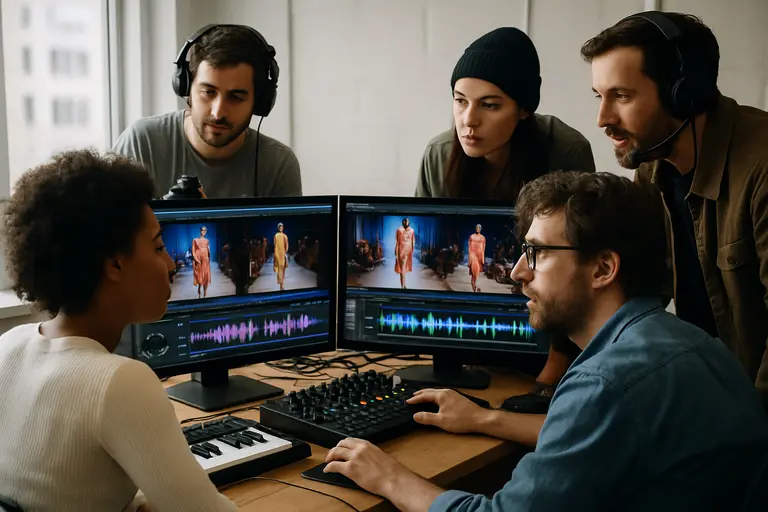
A stem-first workflow fits the 2026 NYFW evidence because the same sonic identity may need to appear across runway, campaign, and social assets. The key is discipline. Stems should be useful groups, not dozens of tiny exports that create confusion. A producer can keep a session adaptable with five to eight clean groups, clear naming, consistent bar starts, and printed effects where the effect is part of the sound.
For adjacent discussion of fashion, technology, and production decisions, RobSonic’s piece on digital fashion music lessons pairs well with this topic. Broader culture coverage from Nextclues offers insights into how fashion moments are packaged across different media, providing a wider context without turning runway cues into a pop production blueprint.
Immersive Translation And Room Awareness
The 2026 research notes also pointed to fashion presentations using wearable audio devices, interactive displays, and high-fidelity playback. Without verified acoustic data from those rooms, it would be risky to claim a single technical standard. The cautious production takeaway is still useful: mixes built for fashion contexts should be checked beyond nearfield monitors.
That means testing mono compatibility, low-end restraint, vocal texture clarity, and transient shape at several playback levels. A cue with too much sub energy may feel impressive in the studio and uncontrolled in a presentation space. A cue with no center information may feel wide but weak on compact devices. The best fashion-informed productions tend to balance spectacle with translation.
NYFW Soundtracks And Modern Production Technique
NYFW Soundtracks did not create minimalism, hybrid scoring, sonic logos, or live cueing. Those ideas existed before the 2026 shows. What the February 2026 cycle did was place those ideas inside a high-pressure format where sound had to support visual identity, move quickly between media, and survive public scrutiny in real time. That makes the runway a useful listening lab for producers, provided the lessons are applied with care.
For aspiring artists, the strongest takeaway is simple: write fewer parts with stronger intent, build motifs that can travel across edits, keep stems organized before the deadline, and test mixes in conditions that resemble the final use. Fashion sound works best when it understands restraint, but restraint is not emptiness. It is the decision to leave enough space for every sound to matter.